
Why AI Needs to Forget

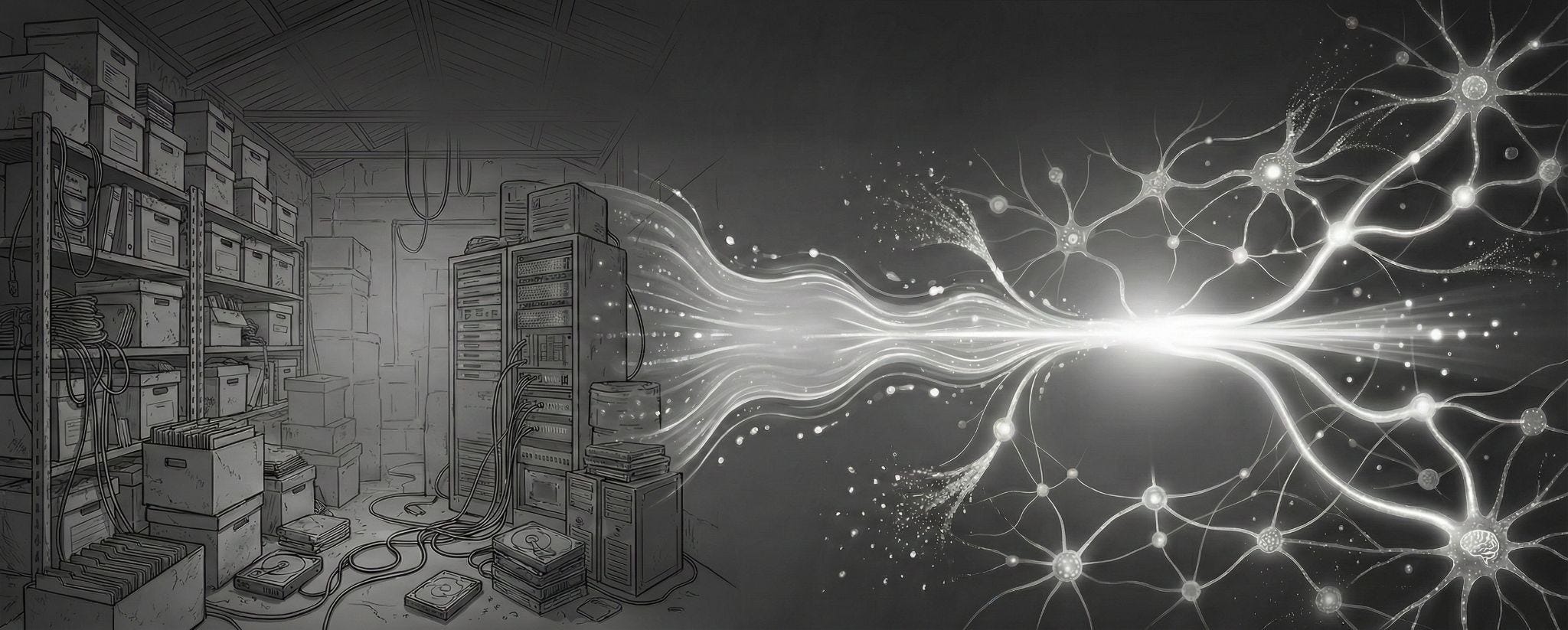
In the last few weeks, the AI/Tech community seems to have collectively realized what biology knew all along, that memory is a graph, not a database.
While they have correctly identified the structure, in the process they seem to have misunderstood the function. Most of the chatter seems to believe that the graph structure is the secret to better AI memory retention. But, they have it backwards, biological memory didn’t evolve into a graph because graphs are good for storage. It became a graph because graphs excel at forgetting.
In a graph, any edge that is not being actively reinforced can be programmed to decay and be forgotten. This isn’t a bug in the system, this is the entire point of the system, of the graph. Biology didn’t choose this architecture for sentimental reasons, it evolved this because it solves a specific engineering constraint that AI is currently hitting, efficiency at scale.
The Retention Paradox
If you pose the question to the community, especially the “Context Graph” advocates, the answer is always something centering on retention. It is defined as memory is an accurate record of events, a “source of truth” that agents (or individuals) can query to see what exactly happened, how decisions were made and somehow deduce the why.
Test this definition on yourself: do you remember all the sensory information that hit your brain yesterday or over any span of time in the past? You have likely forgotten more than 99.999% of all the information that hit your brain. You don’t have a photographic record of your life and most of what you do remember didn’t necessarily teach you a concrete lesson. By the standard of a database or a context graph, your memory is a corrupted, leaky failure.
Yet, no one would argue that you lack memory.
This is the paradox that needs to be resolved: human memory isn’t defined by what is stored or kept; it’s defined by what is successfully thrown away. The “failure” to record every decision trace is a rather sophisticated filter working exactly as intended and should, nah will, be a central feature of whatever memory system eventually wins in the market.
The Evolutionary Mandate
To understand how to build this filtering system, we shouldn’t be looking at archives; instead, we should look at where memory came from in biology. Memory didn’t evolve to let us reminisce about the past or remember our high-school sweetheart. It evolved to help us find food again.
The machinery in the mammalian brain that we use for abstract memory, the hippocampus, is well accepted to have originally been a navigation engine. One of its core components is grid cells, functionally the brain’s internal GPS. They don’t store a static picture of a location, instead it collectively stores vectors that gives information about relationship, distances and direction. This strongly points to the reality that the fundamental unit of biological storage isn’t the snapshot, but a vector.
This origin story explains the fundamental structure of the graph. You don’t just store the destination, you store the path and crucially the paths you stop walking must fade away. Imagine a fruit tree that dried up six months ago. If the brain worked like a “context graph” archive, you would retain that path forever as a record of past decisions, a total waste from a biological lens. If you value finding food (your utility function), a path that leads to nowhere is worse than useless, it’s a hallucination risk.
This is the inverse of Habbian logic that says neurons that fire together, wire together. But, just as importantly, neurons that don’t fire together, unwire. The path to a dead tree isn’t archived for later analysis, it is biologically deleted because in navigation obsolete data isn’t just noise it’s a hazard.
Why “Universal Context” Fails
The biological reality that memory is shaped by a goal explains why “universal” memory is impossible. Imagine a designer, an engineer, and a biologist standing at the exact same spot overlooking the Golden Gate Bridge.
They are going to literally be getting the exact same information. Yet, if you asked them a few days later what they saw I would bet that one would realize that they formed three totally different memories. The designer might recall the Art Deco styling and the “International orange” paint against the fog. The engineer would remember the suspension cables and load distribution. The biological might have forgotten the bridge entirely, remembering only the marine layer and the ecosystem around and below the bridge.
Notice what happened here. It wasn’t just that they selected different features, it was that they deleted completely different things. The engineer didn’t just deprioritize the color, they deleted it. The biologists didn’t compress the bridge, they removed it.
This observer dependence points to a nuance that is totally missed in current AI architectures and conversation, that the utility function must precede the input. This designer’s brain knew to weight aesthetics before they even opened their eyes. Let’s apply this to the agents we are building today. Take a raw transcript of a complex support call.
A technical support agent will extract the error codes and reproduction steps. To work, remembering to work effectively, it must actively forget all the small talk about the weather or other pleasantries.
A sales agent analyzing the exact same transcript needs to ignore the stack trace entirely but deeply encode the customers emotional level deduced through the small talk and also maybe casual mention of a competitor.
If you force both agents to share a single, universal “context-graph” that stores every detail just in case then you aren’t creating memory you are creating noise. Worse, you are creating the same noise for every agent.
This doesn’t mean the conceptually context-graph or graph approach is wrong. It means that treating a graph as a passive container is patently insufficient. To overcome the noise we have to inject the why before the what, we need rapidly come to terms that for memory (context-graph), context filtering is much more important than the context accumulation approach being advocated.
Forgetting as a Feature
Forgetting, therefore, isn’t something that necessarily leads to memory failure; it might be memory working.
If memory is a graph shaped by a utility function, then it’s doing something very specific: lossy compression. It is stripping away noise to keep the signal that matters to a specific observer. It’s turning terabytes of raw experience into a kilobyte of relevant wisdom.
Why not just store everything? Storage is afterall cheap, and modern vector databases can technically hold it all. The answer is something that every AI engineer learns on day 1, overfitting. If an agent remembers every detail of every specific interaction then it cannot generalize. It is not learning anything, it is memorizing specific timestamps and phrasing of past tickets that is not going to be useful in anything. So, the goal of memory isn’t reconstruction but help with prediction for which forgetting the irrelevant information is essential to allow the relevant to generalize.
This is where the “context graph” advocates get it wrong, they see graphs as a strorage container, but its actually a learning system. And, as a learning system, the graph isn’t there to hoard data but a mechanism that decides what to kill.
We’ve Built Search, Not Memory
This brings me finally to the uncomfortable reality of our current stacks, none of the current AI systems that claim to have memory actually have any such things, they have sophisticated retrieval systems that are well… search!
What is popularly being called “context” today, is effectively a sliding window of logs. It’s an uncompressed history, retrieved by semantic similarities. This is an archive with a look up function and not memory. The missing piece is the valuation function. The biological memory knows that some things matter more than others, not because they are semantically similar to the current query, but because they changed something. For instance two specific heuristics to assign this value might be (a) repetition, if a path is walked often enough, the edges thicken. The signal is encoded deeper, (b) surprise, a single, high-entropy moment that violates a prediction gets preserved even if it never repeats. (you only need to touch a hot stove once).
Current so-called AI memory systems can’t really do this. They retrieve what is textually close to the prompt, not what mattered to the outcome. Until AI learns to compress based on subjective utility, to forget strategically, it doesn’t have memory. It has a database with a nicer interface.
Storage to Filtering
As far as good starts go, the community has done well with the realization that memory is a graph though they still need to discover what these graphs are actually for. They are not for storage, they are to enable forgetting. They are edges that can decay, paths that can disappear, and compression shaped by a defined identity. Implicitly, we have been treating context as a storage problem, asking ourselves how to fit more tokens or build ever more complicated graphs.
We have to stop doing that and start treating it as a filtering problem. The next breakthrough isn’t more context; it’s learning what to throw away.
- A.G.